Explainer
Why these habits look older than they are
Most of what gets called ancient custom in China was set in the twentieth century. Here is the pattern behind it.
Last updated
Ask where a Chinese everyday habit comes from and the answer is usually “thousands of years”. Check the record, and the habit is often younger than the person practising it.
The same pattern, three times over
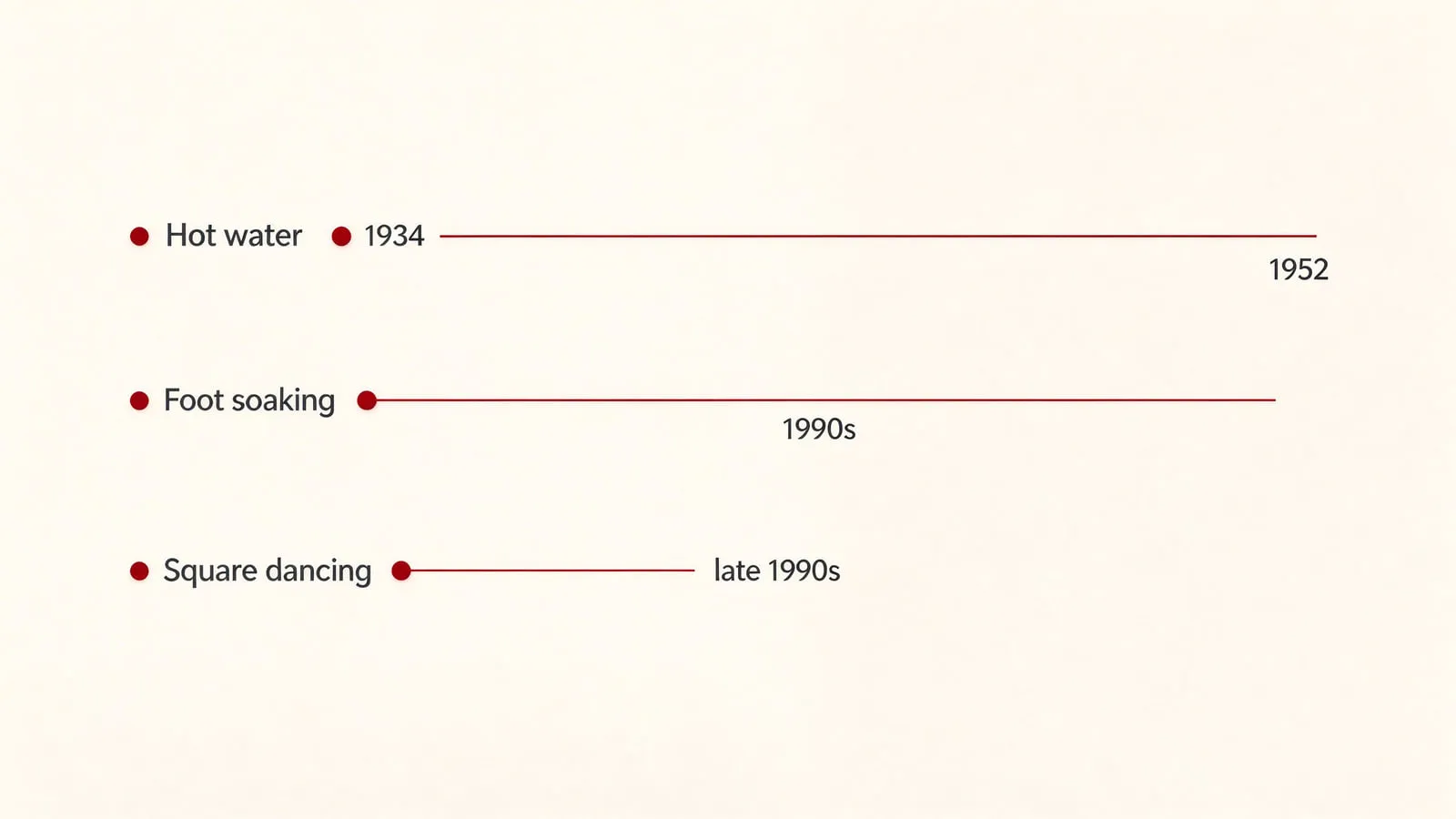
Hot water as the default drink traces to sanitation campaigns in the 1930s and again in the 1950s, not to antiquity. Foot soaking became a mass habit with cheap electric basins, a product of the 1990s and 2000s. Public square dancing filled city parks only in the late 1990s, when a wave of retirees arrived with time to spend. None of these is old. All three are felt as old.
Why the dates go missing
Three mechanisms, and none of them has anything to do with ancestry.
A habit that is cheap to keep survives its own reason: once a thermos exists, hot water costs nothing to continue. Public instruction outlives the problem it was written for: advice issued over water safety in the 1950s stays on the table long after the pipes are fixed. And a habit that already fits an older model of the body needs no argument to stay.
Together they produce the effect visitors notice — something that feels inherited, and turns out to have been assembled within living memory.
What this changes
If a habit is recent, it can be explained rather than admired. There is usually a policy, a product, or a price behind it, and usually a year. That is the whole method here: find the date, and the custom stops being a mystery.
It also raises the standard for what gets written. A habit with no traceable origin does not get a piece.
Where to begin
Pick one habit and go deep. Why hot water is the default drink in China works as a starting point: it looks like the oldest thing on the list, and turns out to be one of the youngest.
Go deeper
-
 Language · 语言
 Why Mandarin is called Putonghua
Mandarin is a Portuguese exonym that never came from Chinese; Putonghua was selected by name in 1955 and defined by the State Council in 1956.
-
 Culture · 文化
 Why tomb-sweeping got a fixed date on the calen…
Tomb-sweeping is old; the public holiday is not. A 2007 revision added Qingming to China's paid holidays, and the first one fell on 4 April 2008.
-
 Buys · 好物
 Why the thermos became a personal object
Hot water only became portable in the 1990s, once a stainless-steel vacuum flask could be made cheaply at home. Here is the object behind the habit.