Buys · 好物
Why the blind box became a hobby
Pop Mart started in 2010. A licensed character in 2016 and a resale market turned a sealed box into a habit.
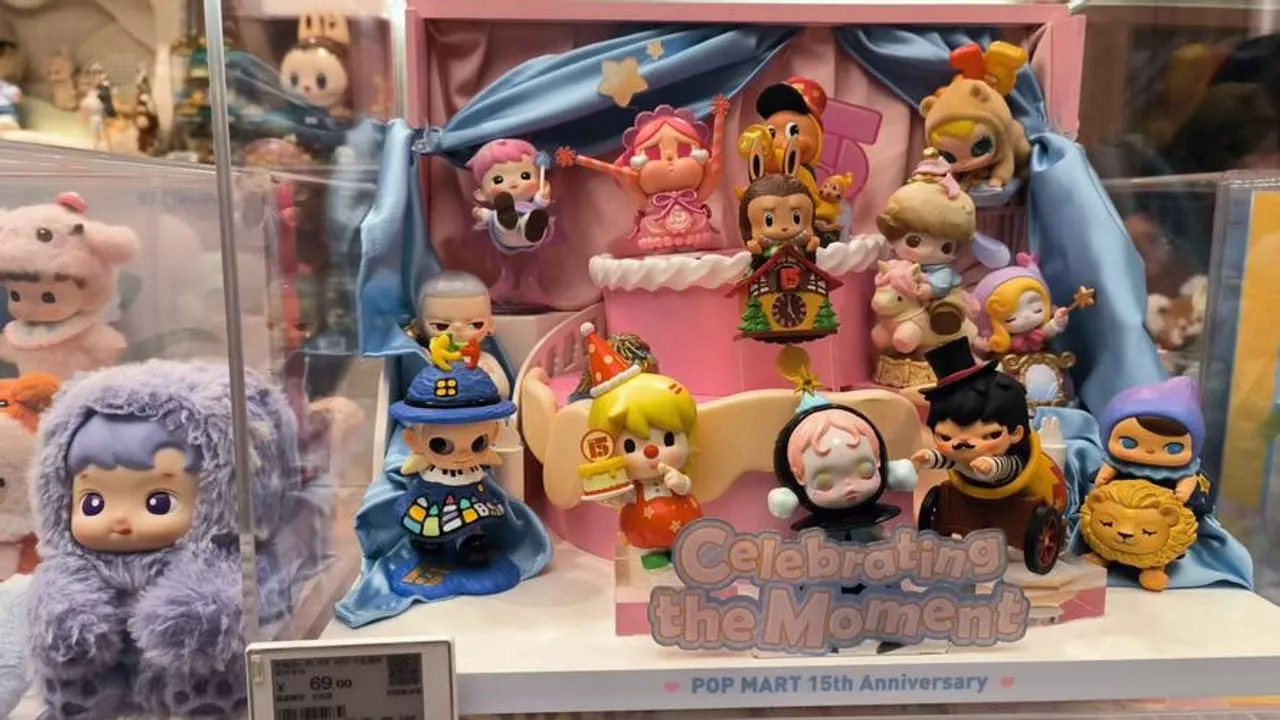
The short answer
- The format is Japanese and older than the company. Pop Mart opened in 2010, cut everything except toys in 2014, and added the thing the format lacked: a licensed character, in 2016.
- The second character was licensed, not built. Labubu was drawn in 2015, licensed by Pop Mart in 2019, and only then sold blind — four years after the drawing.
- The scale is audited. 2024 group revenue was RMB13.04 billion (about $1.8 billion), up 106.9%; The Monsters alone earned RMB3.04 billion, up 726.6%.
The full history, the documents behind it, and the practical reading are below.
The shelf is lit from underneath, and every box on it is the same size. A buyer picks one up, turns it over, sets it back, and lifts it again. The package shows the whole set — a dozen figures, plus one that is left blank. What is inside cannot be known from outside. The buyer pays, breaks the seal at the counter, and finds out. Two boxes later the figure everyone wants is still missing. At home, a line of earlier ones sits on a shelf, a few of them still in their wrappers.
That is the whole transaction. Small money, no instruction, no explanation of where it comes from. People do it on a lunch break and think nothing of it. What is worth stopping on is the age of the thing, because it is not old.
The usual explanation
Outside China, the blind box is usually filed under surprise — a sealed toy, a small lottery, a copy of the Japanese capsule machines that have dispensed random toys since 1965. The habit itself gets filed as a young people’s fad, which is close to true and misses the point. What turned a novelty purchase into a hobby is a company that opened its first shop in 2010, a licence signed in 2016, and a secondhand market that learned to put a price on the draw.
A stationery shop that changed its stock
Pop Mart opened its first store in 2010, selling stationery, cosmetics and accessories alongside a few toys. The founder, Wang Ning, cut everything except toys in 2014 and rebuilt the company around a single format: a sealed box holding one figure from a set, at a price a student could pay.
The format was not Chinese. Capsule toys had been sold this way in Japan for decades, and sealed packs were already standard in trading cards. What Pop Mart added in 2016 was a character. That year it licensed Molly, a figure drawn by the illustrator Kenny Wong, and put her in a box; the first series went on sale in 2016. Part of every set was held back as a “secret” figure, and the share that carried it was small. The small share is the mechanism. It gives an unopened box a reason to be traded instead of simply kept.
The 2016 series also decided the shape of a purchase. The contents were only part of it. A named character, a fixed set and one figure withheld give a buyer something to recognise on the second visit; a shelf of unbranded random toys gives nothing to recognise. Recognition is what turns a second visit from a coin toss into a choice.
The pattern of an object made ordinary by one product decision rather than by a custom is the same one behind why the thermos became a personal object.
The monster, and the numbers underneath it
The second character came from outside the company as well. Labubu was drawn in 2015 by the artist Kasing Lung as one of a set he called The Monsters. Pop Mart licensed the set in 2019 and began issuing blind boxes of its own.
Labubu existed for four years before it was in a box. The set was drawn in 2015, licensed in 2019, and only then sold blind, which is the usual order for a licensed character and the reverse of how the first one worked. Molly was built for the box. The Monsters was brought into it.
The company listed on the stock exchange in Hong Kong, China in December 2020. From there the figures are audited rather than anecdotal. Pop Mart’s 2024 annual results put group revenue at RMB13.04 billion (about $1.8 billion), up 106.9% on 2023. The Monsters alone earned RMB3.04 billion, up 726.6%. Revenue from markets outside the mainland reached RMB5.07 billion, up 375.2%, close to two-fifths of the total. Plush products, a category that had almost no sales a year earlier, grew more than twelvefold in the same period. Those figures are audited and public, which is why the hobby can be dated to a year rather than described in general terms.
The secondhand market that puts a price on an unopened box is filed under collectible resale, alongside the other objects people keep for a reason rather than a use.
Why the box, not the figure
The resale market is the part that makes a cheap toy behave like a holding. A standard box costs the price of a meal; a secret figure from the same box can sell for many times that. The marketplace data follows the same shape. eBay, in its year-end 2025 collectibles report, recorded global searches for Labubu up 2,600% year over year, and sales of blind-box collectibles up more than 470% against 2024. On TikTok, by mid-2025, the Labubu hashtag had been attached to more than a million videos, according to China Daily.
Trading is what turns that price into a habit, and it happens on the unopened box rather than the figure inside it. An unopened box can be sold or swapped between buyers. That is why the unopened box, not the figure, is the unit that circulates, and why the premium attaches to a package nobody has opened.
None of that is needed to enjoy a box, and most buyers never sell one. But it is what turned a single purchase into a repeat one. The unopened box holds an unknown figure, the unknown figure has a public price, and that price is visible before the seal is broken. A draw with a price list behaves differently from a draw without one.
Another habit assembled this recently, and equally dependent on a screen at a counter, is told in why cash stopped being the default.
What it is not, and what it means on the shelf
Three things this account is not. It is not a claim that the blind box is Chinese: the sealed random toy is Japanese in origin and older than any of the companies here. It is not a claim that buying one is an investment; the resale premium is real for a few figures and absent for most of the set. And it is not a description of everyone. It is a habit concentrated in cities and among younger buyers, not a practice followed across the country.
What the resale explanation cannot account for is the shelf. If a box were worth only what it resells for, collectors would sell the figures they did not want and stop. Many do not. Boxes stay sealed for years, and ordinary figures with no premium are kept and displayed. The draw is the point, not the price.
For a visitor, the reading is small and specific. A blind box is a fixed-price lottery with a printed set, and you can buy one without a figure in mind. The Buys section covers other objects whose story is a date rather than a custom; the market half of this one is filed under collectible resale; the wider pattern is under habit origins; and a habit assembled this recently appears again in why cash stopped being the default.
Why it is being copied now (2026)
For overseas audiences the figure arrived before the format did. Labubu appeared at the opening ceremony of the 2026 FIFA World Cup, and the 2026 Chinamaxxing trend names Chinese designer toys alongside Luckin Coffee and Mixue as consumer goods Western audiences met first — the trend’s hashtags had passed four billion cumulative views by mid-2026.
The resale data marks the same shift from outside. eBay’s year-end 2025 collectibles report recorded global searches for Labubu up 2,600 per cent year over year, and sales of blind-box collectibles up more than 470 per cent on 2024. Revenue from markets outside the mainland reached RMB5.07 billion in 2024, up 375.2 per cent, close to two-fifths of the total.
What is being copied is not a Chinese tradition. It is a Chinese product, sixteen years old, built on a Japanese format and a licensed drawing.
Common questions
Is the blind box a Chinese invention?
No. The sealed random toy is Japanese in origin and older than any company here — capsule machines have dispensed random toys since 1965, and sealed packs were already standard in trading cards. Pop Mart opened in 2010 and changed the stock; what it added in 2016 was a character.
Why do people buy a box they cannot see inside?
Because the unopened box is the unit that circulates. A standard box costs the price of a meal, a secret figure from the same box can sell for many times that, and the resale market that sets that price grew more than 470 per cent in 2025. Because the box has not been opened it can be sold or swapped between buyers, and a draw with a price list behaves differently from a draw without one.
Is a blind box a good investment?
The resale premium is real for a few figures and absent for most of the set, so this is not an investment claim. What the numbers do show is scale: group revenue of RMB13.04 billion in 2024, up 106.9 per cent, with The Monsters alone at RMB3.04 billion, up 726.6 per cent.
Do collectors actually keep the boxes?
Many do, and that is what the resale explanation cannot account for. If a box were worth only what it resells for, collectors would sell the figures they did not want and stop. Boxes stay sealed for years, and ordinary figures carrying no premium are kept and displayed. The 2024 annual results count the same behaviour from the other side: group revenue of RMB13.04 billion, up 106.9 per cent.
The documents behind this
- Pop Mart’s 2024 annual results — group revenue of RMB13.04 billion (about $1.8 billion), up 106.9 per cent on 2023.
- eBay’s year-end 2025 collectibles report — global searches for Labubu up 2,600 per cent year over year.
- The 2016 Molly licence, drawn by the illustrator Kenny Wong — the first character built for the box rather than brought into it.
- The 2019 licence of The Monsters, drawn by Kasing Lung in 2015 — the reverse order, a drawing brought into a format that already existed.
Where this goes next
The Buys section covers the objects people actually keep and why; the market half of this one is filed under collectible resale, the object itself under blind box, and the trend carrying it abroad under chinamaxxing.
Products rather than customs are the subject of why the thermos became a personal object; a habit assembled just as recently is in why cash stopped being the default; and the general pattern is under habit origins.
Written and checked against published sources. See how we work
Keep reading
 Buys · 好物
Why the thermos became a personal object
Glass vacuum flasks stayed on the table for most of the century. A 1994 Chinese copy of a 1988 Japanese original is why hot water now follows you around.
 CityLife · 城市
Why one app runs the whole day
The app launched in 2011 as a messenger. Payment arrived in 2013 and mini programs in 2017; by 2024 it reported roughly 1.4 billion monthly users.
 Culture · 文化
Why the New Year date moves every year
The lunisolar calendar is old. The Gregorian switch came in 1912, the name in 1914 and the paid holiday in 1949; it falls between 21 January and 21 February.