Food · 中国味
Why one finger measures the water in rice
The finger went in before the marks did. A 1958 instruction booklet taught water levels, and a 1990s pot replaced both.
The short answer
- The finger came before the line. The first automatic rice cooker from Toshiba in 1956 had no water mark, and Panasonic’s first fully automatic model in 1958 shipped with a booklet of recommended water levels rather than a printed scale.
- Mass production printed the marks. The second generation of Chinese cookers, made from 1978, put lines on the inner pot; national output passed 10 million units in 1987, and the appliance was in 60 per cent of rural households by 1999.
- The method outlived its reason. Adding a finger still works, and the industry standard that took effect in April 1996 still concerns the appliance rather than any rule about how much water rice should get.
The full history, the documents behind it, and the practical reading are below.
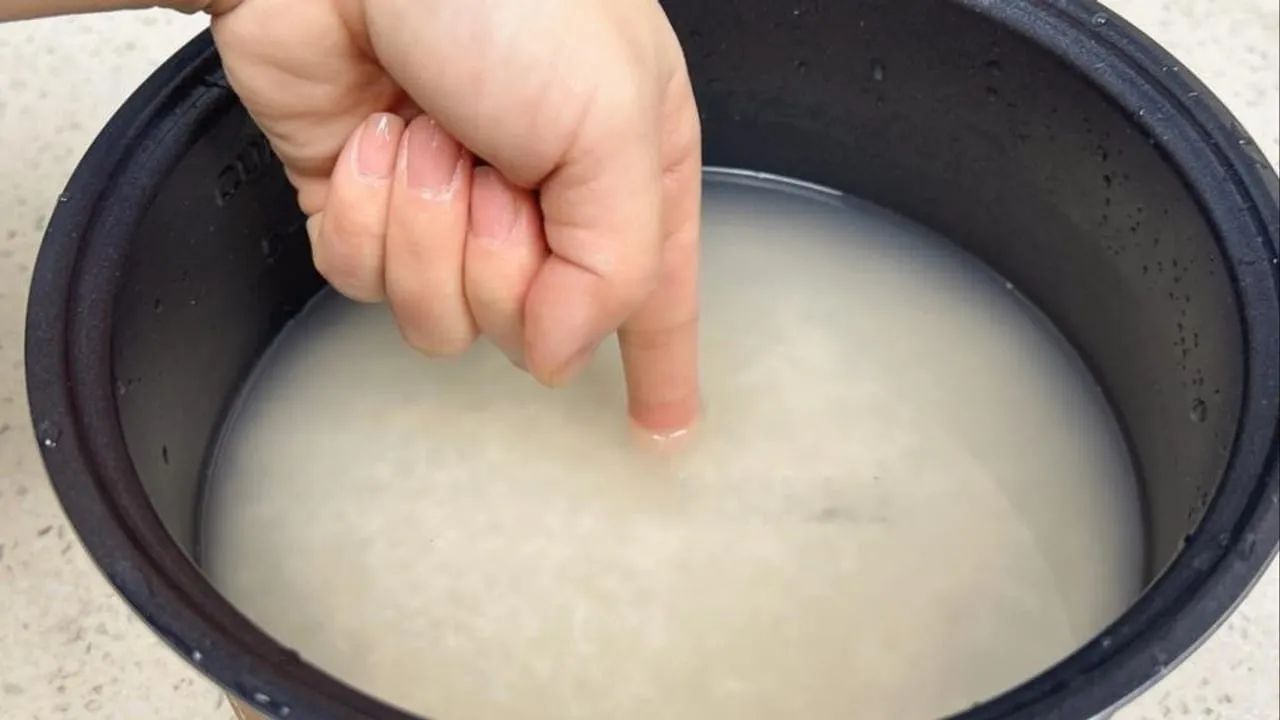
The rice goes in first, spread flat with the back of a hand so the layer is even and not heaped at one edge. Water is poured in slowly, and then a finger goes straight down, vertically, until the tip touches the rice and the surface closes over the first knuckle. That is where the pouring stops. It is a gesture with no measuring equipment in it, repeated in kitchens where the same pot has been used for years and never once read.
Outside China the gesture gets described as a talent, which is the one thing it is not. Nobody is estimating. The finger is standing in for a water line that the pot did not have.
The usual explanation
Two explanations get offered, and only one of them survives a date check.
The first is that a lifetime of practice makes the hand accurate enough that a measurement is unnecessary. That account has a real difficulty: it is a claim about skill, and skill implies the learner had something to calibrate against. There was nothing to calibrate against. The earliest household rice cookers carried no line for water, no cup, and no numbers — a measurement had to come from somewhere else, and the hand was what was available.
The second explanation gets closer, and it is a story about hardware. The method worked because it had to. Before a pot printed a scale, a cook had no way to know the ratio except by judging it, and judging it by hand is what a household does when nothing else exists.
That explanation is not a refutation of the first so much as a relocation of it. Accuracy was never the point, and the hand was never calibrated against anything — the practice filled a gap that then closed.
A cooker with no line on it
That first machine was not Chinese. Toshiba released the first household automatic rice cooker in December 1956, and it worked by heating an outer pot until the water between the two pots boiled away, at which point a mechanical sensor cut the power. It sold by canvassing door to door, and the shape it established — an outer vessel, an inner vessel, a sensor that watches for dryness — held for a decade.
The improvement that matters here came from Panasonic. In 1958 its engineers took the double-pot arrangement and flattened it into a single inner pot heated directly from below, which made the appliance something a household could live with rather than demonstrate. The standard version came with a small instruction booklet setting out recommended amounts of water for different textures of rice.
That booklet is the hinge. It is the point at which a water level stopped being something a person guessed and became something a manufacturer published, and it is also the point at which the hand and the written number start to disagree. Chinese buyers were not choosing between a finger and a book. Both arrived at roughly the same moment, and the finger was already in the hand.
The line that replaced the guess
The first machines to reach China in meaningful numbers arrived in the early 1960s, when buyers ordered a hundred or so units through Hong Kong as a way to test the market. They were display pieces rather than kitchen tools, and they came without the domestic support that would make them ordinary.
That changed over two decades. In 1978 an appliance factory in Guangdong began producing the second generation of Chinese cookers, using a magnetic temperature sensor instead of the bimetal switches the imported machines relied on — a part that was difficult to make, which is why producing it mattered as a milestone in its own right. During the 1980s the same city and others in the province turned out the machines under names still on shelves today, and output was still under 20,000 units a year at the start of the decade against 800,000 by the end of it.
1987 is the year national production broke 10 million. By the middle of the 1990s the appliance was effectively standard in urban kitchens, and the range of models had widened enough that a single household could own two. Industry figures put the market past 50 million units by 1996 and past 100 million by 2005, when Chinese output accounted for roughly 70 per cent of the world total.
What survives all of this is a habit with no date at all. Nobody decided on it.
The printed scale came with this run rather than before it. Marks on the inner pot are cheaper to produce once there are millions of pots, and the convenience that made a finger necessary disappeared as the line got cheaper to print. By 1999 the appliance was in more than 60 per cent of rural households.
The habit did not get an exit notice, and this is the part that is easy to miss. A line already inside the pot answers the question the finger was asked to answer, so most households stopped using the finger and kept the memory of it. The gesture survives in the gap between having a scale and trusting it.
The parts the finger cannot do
A finger is a reasonable instrument for one pot of one rice. It is a poor one everywhere else, and the reasons are measurable rather than matters of opinion.
The ratio a hand reproduces is roughly one part water to one and a half parts rice by weight, which suits ordinary long-grain rice and misses at both ends of the range. The error compounds with the amount being cooked, since the depth of the rice layer changes while the knuckle stays where it is.
Too little rice and the water is too much. A single cup in a large pot gives a shallow layer, and one knuckle of water over a shallow layer is a lot of water. The same gesture in a full pot is not enough.
The rice variety moves the target too. Long-grain indica drinks more than the round northern japonica that most standard ranges assume, and aged rice drinks differently from rice out of the last harvest, which still holds moisture of its own.
That is the whole difficulty with the method, and none of it is mysterious or specifically Chinese.
The people who say so publicly are usually not enthusiasts. A Chinese culinary director quoted on the question in 2020 pointed out that palm thickness varies from one and a half to three centimetres between adults, that finger lengths differ too, and concluded that measuring by hand carries large error for a beginner, with the graduated cup being the better tool.
The accuracy belongs to the cup, and that is the part worth being precise about. What the finger has instead is the advantage of being already there.
The habit is not Chinese in any special sense, and that is worth saying early. It is what a household does when the equipment has nothing printed on it.
What it is not, and how to cook rice here
Three things this account is not. It is not a claim about taste: nothing here argues that rice made with a finger tastes better or worse than rice made with a cup, and the question was never investigated that way. Nor is it a claim that the method is unsafe — the concern with undercooked rice is a matter of starch, not of measurement, and it is unchanged by which method is used. And it is not a description of everyone: plenty of households read the scale, plenty of others measure with the cup that came in the box, and plenty more do not cook rice often enough for any of it to matter. What the record does show is a piece of equipment history. The method is a leftover, not a preference, and the reason it disappeared is that the pot acquired a mark.
The practical part is small, and it is about your own kitchen rather than anyone else’s. The inner pot of a modern cooker is marked, and the markings are set out by cup count — a pot marked to 5 expects five cups of rice and a line to match. The cup that came with the appliance is the measuring instrument the marks assume, and using a different container changes what the numbers mean. The finger method that everyone jokes about is still accurate enough for a single ordinary batch; it is the errors at the edges that make people switch.
The wider pattern is collected under Food, the appliance itself is filed under rice cooker, and the body of advice that treats rice as the thing a household must get right is covered under habit origins. The same pattern of a tool replacing a gesture appears in why Chinese households keep every plastic bag, where a printed price did nothing to empty a drawer.
Why it is being copied now (2026)
The finger is not part of the Chinamaxxing trend, and the reason is instructive: the trend runs on purchases and visible routines, and this is a measuring gesture nobody films.
What travels instead is the appliance, which is now an ordinary object in overseas kitchens in a way it was not five years ago. Electric rice cookers sit alongside the coffee machine, and the slow-cooker argument — that a single pot can run unattended and produce a meal rather than a component — is repeated constantly on kitchen channels. Almost all of that conversation is about capacity and programmability.
The water ratio gets mentioned only in passing, and when it does it is described as a folk method. It was a piece of engineering response to a missing water line, and the line is sitting inside the same pot now.
Common questions
Is measuring rice water with a finger actually accurate?
Within a narrow range, and with an error that is larger than most people assume. The hand reproduces roughly one part water to one and a half parts rice, which suits ordinary long-grain rice in a normal batch for one cook. A Chinese culinary director noted in 2020 that palm thickness varies between about one and a half and three centimetres, and that the error is significant for beginners, particularly when cooking small or large batches.
Why did people use a finger before rice cookers had water marks?
Because the early machines had no scale to read. Toshiba’s first automatic cooker in 1956 heated an outer pot until the water between vessels boiled away and had no water mark at all, and early Chinese imports from the early 1960s came as display pieces without domestic support. When a printed line finally appeared on inner pots from the late 1970s, there was finally something to read.
Do modern rice cookers still have water lines?
Yes, and this is why the finger method faded rather than improved. Inner pots are marked by cup count, with a water line for each cup of rice, and the cup supplied with the appliance is the unit those numbers assume. Printing a mark became cheap once pot production reached millions, so the measure that made the gesture unnecessary arrived alongside the appliance.
What is the correct rice-to-water ratio?
There is no single figure, and anyone giving one is describing their own pot. Long-grain indica rice absorbs more than the round japonica that most standard ranges assume, and rice from the last harvest carries its own moisture while aged rice needs more. The graduated cup in the box is a better instrument than a finger, because it is consistent between batches.
Do Chinese households still measure rice water by hand?
Fewer than they did, though the gesture has not disappeared. Reported figures put the appliance in over 60 per cent of rural households by 1999, and the marks inside the pot answer the question the finger was asked to answer. Households that read the scale stopped using the finger and kept the memory of it, which is why the method survives as something people joke about rather than something they describe as practice.
The documents behind this
- Toshiba’s first household automatic rice cooker, December 1956.
- Panasonic’s first fully automatic cooker of 1958, which replaced the double pot with a single directly heated inner pot.
- Production of the second generation of Chinese rice cookers beginning in 1978 at an appliance factory in Guangdong, using a magnetic temperature sensor in place of imported bimetal switches.
- The industry standard for automatic rice cookers, in force from April 1996, which concerns the appliance rather than any rule about how much water rice should receive.
Where this goes next
The Food section covers how meals are ordered, shared and timed. The appliance is filed under rice cooker and rice, the household standard behind it under household objects, and the wider habit under habit origins.
For the same pattern in a different object — a printed rule that changed the price and left the habit alone — read why Chinese households keep every plastic bag. For why a practice like this can feel far older than the equipment that produced it, see why these habits look older than they are, and for the other side of the counter see why cash stopped being the default in China.
Written and checked against published sources. See how we work
Keep reading
 Buys · 好物
Why the thermos became a personal object
Glass vacuum flasks stayed on the table for most of the century. A 1994 Chinese copy of a 1988 Japanese original is why hot water now follows you around.
 Wellness · 养生
Why hot water is the default drink in China
Hot water is China's default drink because of a 1934 hygiene drive, a 1952 public-health campaign and a 1985 water standard — not because it is ancient.
 Food · 中国味
Why Chinese households keep every plastic bag
China banned ultra-thin plastic bags in 2007 and priced the rest from June 2008. Reported retail bag use fell by two thirds, and households still keep them.