CityLife · 城市
Why China has a scrubbing service
It began as a workplace benefit, not a luxury. A 1999 film made it famous, and a 2010 guideline made it a business.
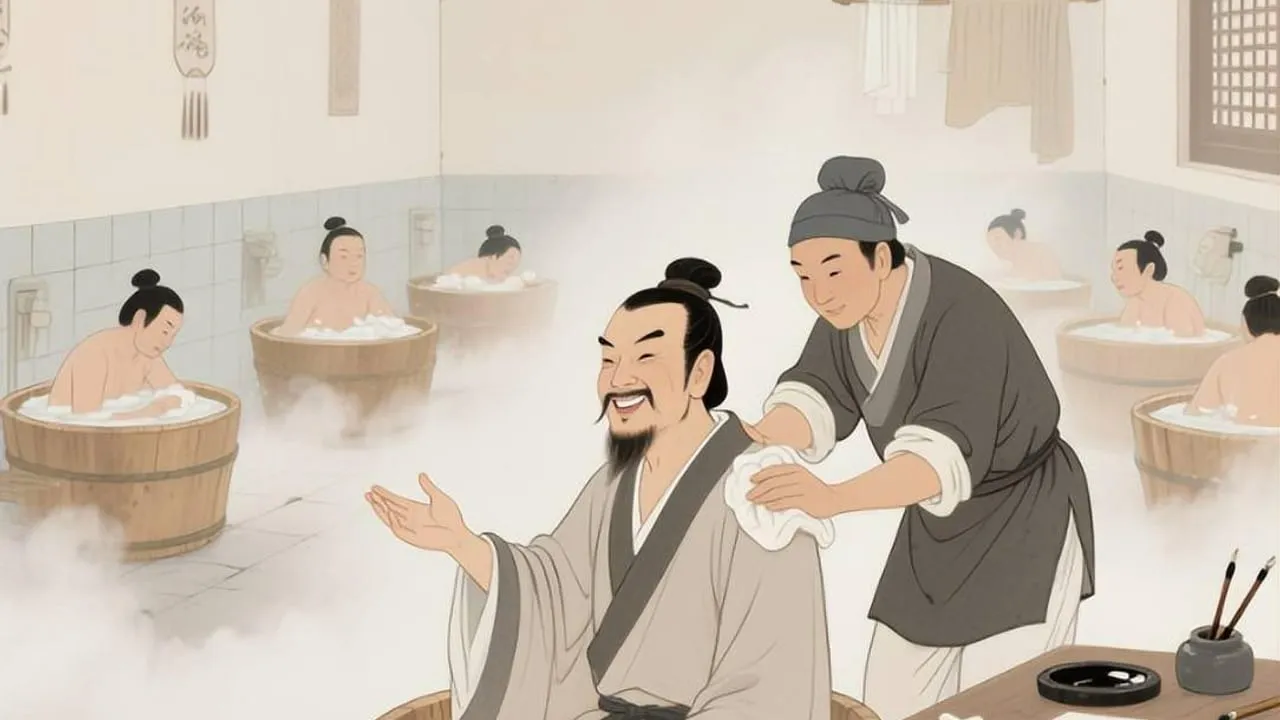
The short answer
- It was a benefit before it was a service. Baths attached to state-owned workplaces were part of the same package as the factory school and the clinic, and in that arrangement nobody was paid to scrub anybody. A 1990 account of one such bathhouse priced a wash at under one yuan, with most households managing one every two weeks to a month.
- The turning point came from outside. Hong Kong sauna culture reached the north in the 1990s, paying for a professional scrub arrived with it, and a 1999 film made the practice visible nationwide.
- By the time it became a business, the original institution was gone. Most workplace baths closed around 2000, and the Ministry of Commerce issued guidance on the sector in 2010 — a decade after the buildings disappeared.
The full history, the documents behind it, and the practical reading are below.
You are handed a wooden board and told to use it. There is a stool, a bucket, and a wall of lockers, and somebody at the door is going to scrub your back in about twenty minutes for a small fee. The towel is not the point. Nobody has come here to be clean exactly — everybody in the room has already showered, and now they are waiting on a bench in a swimsuit for a stranger to work on their shoulders.
It is one of the more confusing things to walk into without context. The reason it exists is not hygiene, and not hospitality. It is what happened to a benefit when the workplace that provided it stopped existing.
The usual explanation
Two explanations get offered, and neither survives a date check.
The first is cultural: Chinese people have always scrubbed, baths have always been social, the practice simply comes down through the centuries. The dates do not support that. Public bathing in the north is genuinely old — hot springs were developed in the Tang period and commercial bathhouses existed in Song times — but the thing people are queueing for is a workplace service that dates from the industrial state, not from any of it. The old tradition supplied the tub. It did not supply the scrubber board, the twenty-minute slot, or the price.
The second explanation is that it is about health, which is the version that gets repeated abroad and is the one least supported by anything. What the service does is mechanical. It removes what a shower leaves behind. Whether a body benefits from that is a question nobody involved in the arrangement was ever required to answer, and the accounts of how it started describe an institution rather than a wellness practice.
The mechanism underneath both is an employment one, and it is the only one that holds up against the dates: baths were built by employers, run by employers, and closed by employers.
A benefit with a building attached
The cold is the precondition for all of it. Northern winters are long enough that keeping a household hot enough to bathe in every day of the year was a real expense, and heating water at home for a family meant fuel most households did not want to spend on anything so ordinary as washing. Where coal was cheap the arithmetic was still bad — one family’s furnace, one family’s water — which is why the answer became a shared building.
State-owned industry supplied that building, and the supply came as part of a package. A large factory in the northeast had a school, a clinic, a canteen and a bathhouse, all of them free or near-free to staff, and the arrangement was understood as compensation rather than as a service with a market. What the bathhouse did not have was a paid role. People scrubbed each other. It was a favour inside a building that had no reason to charge for anything.
Recollections of those places are specific about the conditions. A surviving description of a bathhouse in the 1980s describes a few rusting shower heads, a single shared pool, and a New Year week when the pool was so crowded that people were packed into it the way dumplings go into a pot of water. The fee was under one yuan, the queue was long enough that many households bathed once every two weeks or once a month, and some people did their laundry in the room, including bedding, because the hot water was already there and the alternative was carrying it home.
The sauna arrives
In the 1990s the arrangement started to fail for a reason that had nothing to do with hygiene. Industry was narrowing, factory payrolls were shrinking, and the bathhouses were a cost that survived only while the employer did. Some closed through the 1990s; most of the state-run ones were gone by around 2000, leaving the buildings repurposed and the attendants out of work.
What filled the gap did not come from inside the region. Hong Kong and Taiwan sauna culture had been visible for years, and with it came something the workplace baths had never had: a paying customer who wanted one specific thing done to them. Bathhouses in the north rebuilt themselves around that — bigger pools, marble, carved columns, and above all a scrubber who could be hired for a single part of the body for a stated price.
The 1999 film that gave the practice its public image arrived at almost exactly the right moment. It told a story about a family-run bathhouse and what happened to the people who worked in it, and it made the institution legible to people who had only ever seen the version that charges by the hour.
A third version arrived in the 2010s, built around hot rooms, steam and services bundled into one building, with food and drink attached so that a booking takes a whole afternoon. The change is mostly a packaging change. The core service has been the same one thing for fifty years.
What the numbers say
The sector grew into something measurable, and the measurements are large enough to be worth stating without dressing them up.
Industry figures put the annual value of scrubbing alone at around 140 billion yuan, which is a number about the size of a mid-sized national industry and considerably larger than most visitors assume when they see the price on the wall.
The physical scale of individual establishments is equally far from the old bathhouse. Industry reporting found that only about 10 per cent of bathing centres nationwide occupy more than 5,000 square metres, while half of the larger operators in the north meet that figure and the largest exceed 100,000 square metres — a floor area comparable to fourteen football pitches in one building. The old pool and a few shower heads have become a hall.
Regulation arrived late and in pieces. The Ministry of Commerce convened a national conference on the sector in 2007 and issued guidance on how bathing businesses should operate in 2010, alongside technical standards for the bathing and spa sectors. The interesting part of that timing is that formal standards for a trade arrived roughly a decade after the institutions that created the trade had closed, in a different set of buildings, serving a different customer.
What it is not, and what to expect
Three things this account is not. It is not a claim that a professional scrub is better for a body than washing at home, because nothing in the institutional history turns on that and no part of this account makes the comparison. It is not a description of all of China: this is a northern practice, it was built for industrial workplaces, and it has never been a national default the way, say, a compulsory holiday has. And it is not a story about hygiene standards, which is the reading visitors most often take from it.
The scrubber’s actual work is friction. A wooden board or a rough cloth removes what a shower has already softened off the skin, and the twenty minutes is the part people pay for. The heat, the steam, and the long soak afterwards are what a household without a working boiler cannot easily arrange at home, which is the connection to the original building that tends to get lost.
What to expect if you go: a bench, a board, a timer, and a small fee paid at the door or at the desk on the way out. Some places will ask before starting and some will not. Nobody will explain anything, because the people running these businesses have been doing it for decades and assume the customer knows the arrangement.
The wider pattern is collected under Food, the habit of hot water is covered in why hot water is the default drink in China, and the containers that travel with people in why the thermos became a personal object. The same institution-to-market shift shows up in why cash stopped being the default in China, where a workplace-issued arrangement was replaced by a consumer one.
Why it is being copied now (2026)
Bathing is not on the Chinamaxxing list, and the reason is straightforward: the trend runs on things a person can adopt at home, and this one needs a building with a boiler.
What does travel is the observation, not the practice. Visitors write about the scrubbing, and they write about it in the language of surprise rather than admiration, which tends to reproduce badly. The institutional version — a benefit that became a business when its employer left — does not make it into those accounts at all, and it is the part that explains why a wooden board costs what it does in a region where a decade earlier nobody was paid to do it at all.
The version that does travel, and travels well, is the thermal one. Hot rooms, steam sessions and the practice of showing up at a specific hour for heat have their own separate lineage and their own separate international following.
Common questions
Why does China have a scrubbing service?
Because scrubbing started as unpaid work inside a workplace benefit. Baths built by state-owned employers were part of a package with the factory school and clinic, so there was no role and no fee. Paying for someone to scrub your back arrived with Hong Kong sauna culture in the 1990s, once there was a customer willing to pay for one specific service.
Is it just for hygiene?
No, and the origin explains why. The service is mechanical rather than therapeutic, and it never had to justify itself on health grounds, because it was not sold — it was provided. The practice is best described as thorough removal rather than as cleaning, since a shower has already done that part before anyone is handed a board.
Is this a Chinese tradition?
The tub is old; the service is not. Public bathing in the north goes back centuries, with hot springs developed in the Tang period and commercial bathhouses in Song times. The scrubber board, the twenty-minute slot and the price came from the industrial state and from Hong Kong sauna culture arriving in the 1990s, which is why the practice was still a workplace benefit rather than an old custom when it started being written about.
Is it everywhere in China?
No, it is a northern practice and it was built around industrial workplaces. It is not a national default in the way a compulsory public holiday is, and visitors looking for it in the south will have less luck. The buildings that hosted the old version have almost all closed, so the version now operating is in newer, larger and more commercial premises.
How much does it cost?
Less than most visitors expect for the scrubbing portion itself, though the rooms at the larger northern centres have grown into something closer to a full afternoon’s entertainment, with heat, food and drink attached. Industry figures put the annual value of scrubbing alone at around 140 billion yuan, which is a good indication of how many people buy it.
The documents behind this
- The closing of state-owned workplace baths, concentrated in the late 1990s and around 2000, as industry narrowed and the buildings were repurposed.
- A national conference on the bathing industry convened by the Ministry of Commerce in 2007, which led to technical standards for the bathing and spa sectors.
- Guidance on the development of the bathing industry from the Ministry of Commerce, issued in 2010, setting out how bathing businesses should operate.
- Industry reporting on bathing centre floor area, finding roughly 10 per cent of centres above 5,000 square metres nationally, with the largest northern operators above 100,000 square metres.
Where this goes next
The Food section covers how meals are shared and timed, and bathing belongs to the same household routine. The practice of heating water at home is covered under hot water, the containers and rooms that make it possible under city routine, and the wider pattern under habit origins.
For the containers that follow people around, read why the thermos became a personal object; for the other major northern custom with an institutional origin, why everyone does baduanjin in the park covers the same question in a different form. For why a facility like this can feel ancient while dating from the twentieth century, see why these habits look older than they are.
Written and checked against published sources. See how we work
Keep reading
 Buys · 好物
Why the thermos became a personal object
Glass vacuum flasks stayed on the table for most of the century. A 1994 Chinese copy of a 1988 Japanese original is why hot water now follows you around.
 Wellness · 养生
Why hot water is the default drink in China
Hot water is China's default drink because of a 1934 hygiene drive, a 1952 public-health campaign and a 1985 water standard — not because it is ancient.
 Food · 中国味
Why Chinese households keep every plastic bag
China banned ultra-thin plastic bags in 2007 and priced the rest from June 2008. Reported retail bag use fell by two thirds, and households still keep them.